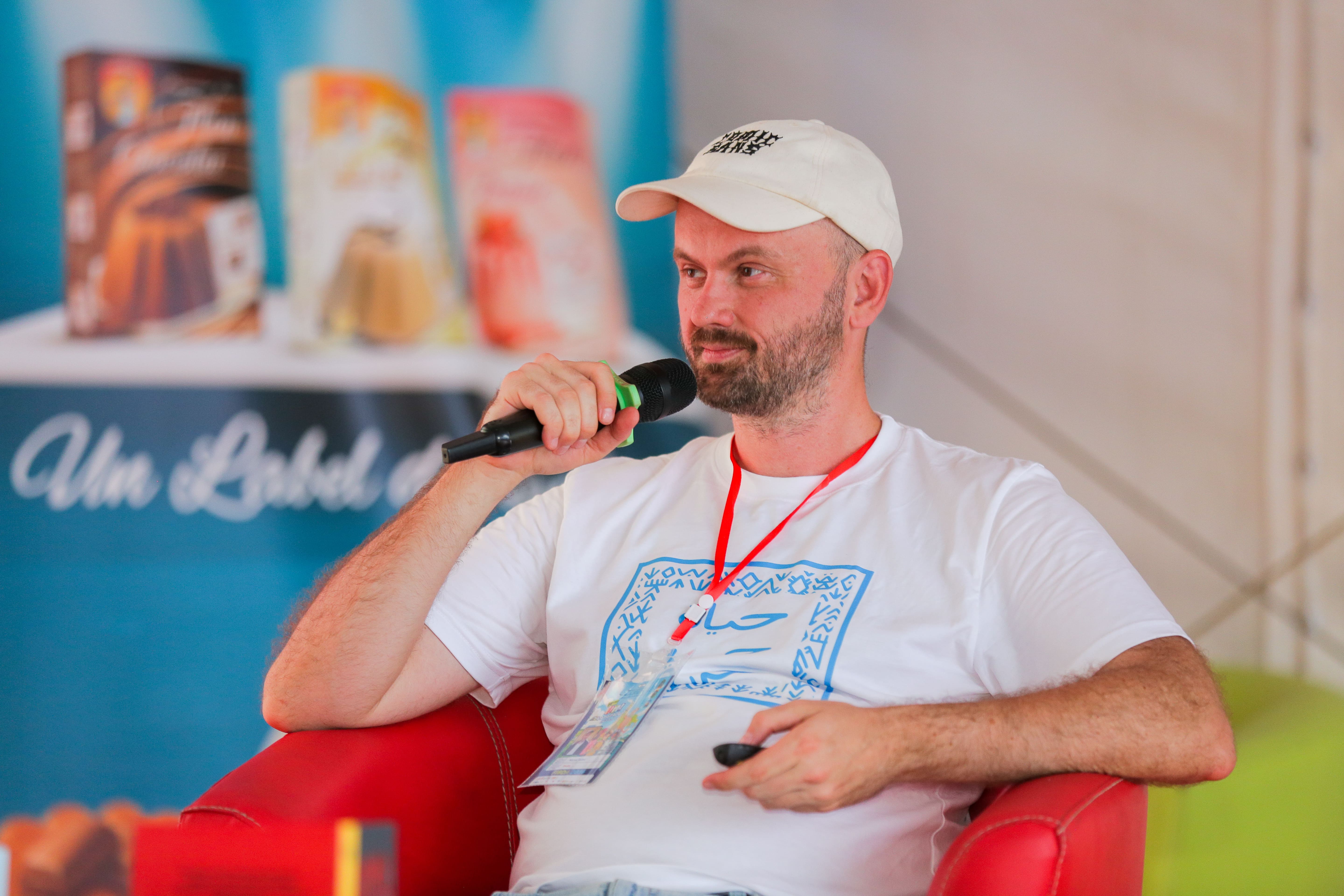
Czech comics have more than a century of stories to tell. From popular characters to darker worlds, from children’s stories to graphic novels, they have evolved over the decades, embracing a wide range of styles and influences. On Saturday, October 3, Czech author and illustrator Marek Rubec offered, as part of the FIBDA conference programme, a journey through this rich history, which he divided into four major periods: from 1900 to 1950, from 1950 to 1989, from 1990 to 2000, and a contemporary period that is much harder to confine to a single trend.
To begin this journey, Marek Rubec focuses on an essential figure: Josef Lada, regarded as one of the pioneers of Czech comics during the first half of the 20th century. His distinctive style and humour left their mark on several generations. Lada, whose work was notably praised by Pablo Picasso, helped popularise speech bubbles and humorous captions. The Czech artist is a historic reference for Marek Rubec and also a direct source of inspiration. His own work, infused with dark humour and satire, was notably featured in a major exhibition in the Czech Republic, created in a style inspired by Lada. It was a way of bringing historical memory and humour into dialogue.
Another key figure of this first period was Ondřej Sekora, creator of Ferda Mravenec, or “Ferda the Ant”, and the beetle Pytlík. His humorous stories and endearing characters made him one of the most popular illustrators of his time. In this largely light-hearted world, other characters also enjoyed their moment of glory. Artuš Scheiner, for example, created Kulihrášek, a small character somewhere between a gnome and a child. His world stood out for its panels, which were almost entirely devoid of speech bubbles and text. Once hugely popular, the character has now largely faded into obscurity. In the 1930s, René Klapač also found success with a magazine featuring the adventures of baby dogs. The phenomenon quickly extended beyond magazine pages: toys, masks and other merchandise testified to their popularity. Then came Jan Fischer and “The Quick Arrows”, a work that became emblematic of Czech comics and remains highly popular in the country to this day.
The Era of Academies and Openness to Outside Influences
Alongside these stories aimed at younger audiences, Czech comics also began exploring more adventurous territory. Pirates, cowboys, scouts, action stories and narratives aimed at teenagers and young adults gradually found their place. The illustrations of Bohumil Konečný, particularly popular until the late 1950s, contributed to this evolution. His works have endured through the decades and continue to be published or reissued. Comics also began paying greater attention to everyday life, notably through stories centred on young women, such as “Zuzanka”.
The 1950s and the following decades saw several magazines establish themselves as major references. Artistic training also played an important role. At art academies, authors were encouraged to develop their own distinctive visual signature. The result was an astonishing diversity of styles. Jaroslav Malák and Jiří Kalousek’s stories for young readers existed alongside the darker world of Adolf Born, while Stanislav Holý created, with “Mr. Pip”, a colourful world largely free of speech bubbles. Science fiction and adventure also found an audience thanks to authors such as Marko Čermák, Jiří Petráček, Vlastislav Toman and František Kobík.
As the country evolved, outside influences multiplied. In the 1980s, the aesthetic of French artist Mœbius, in particular, resonated with Czech authors, while new specialised magazines began to appear. Oldřich Jelínek’s science fiction, Jan Štěpán’s stories, Lucie Lomová’s works for young readers — she was one of the first major female figures in Czech comics — and Vladimír Tučapský’s experimental collages all reflected this new creative freedom.
A Contemporary Scene in Full Fragmentation
From the 2000s onwards, a new generation took over in an increasingly fragmented landscape. “There is no longer really a dominant trend,” Marek Rubec points out. Styles, formats and subjects multiplied, while festivals and new publishing opportunities provided artists with new spaces for expression.
Born in 1979 in Litoměřice, Marek Rubec knows this history well, as both an observer and a participant. A comic book author, independent illustrator and animator, he has published his stories in numerous magazines and anthologies across Europe and received several awards. He is also the first Czech artist to create a Google Doodle and the author of historical graphic novels. His work, which combines humour, satire and a sensitive perspective on the small towns of Central Europe, ultimately extends, in its own way, a deeply rooted tradition in Czech comics: telling the stories of history, ordinary people and great upheavals through a personal artistic style… and, often, with a healthy dose of humour.